
Public Works Service Center Complex Update August 2025

Lots 2, 3, 4, 5, 6, 7, East Riverside Park Addition – 1416 Main Street East

Delivery of building

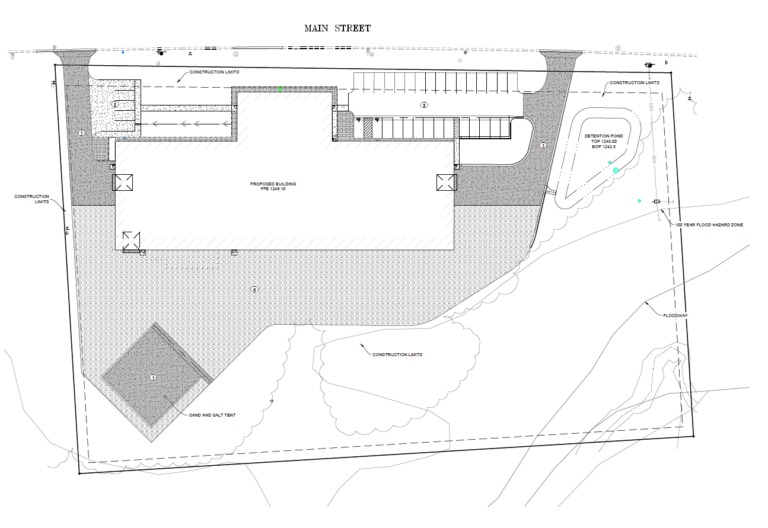
  • On March 4, the Board of City Commissioners approved the purchase of a pre-engineered metal building, which when finished will house 40,438 square feet of equipment storage, shop space, and office facilities for the various public works departments.
  • Foundation work began over the summer.
  • Building components began arriving in August.
  • Construction is expected to begin this fall.

Soil remediation

  • Heavy rains on August 5 required additional mitigation for the land treatment site on Lot 3, Industrial Park Addition (south of former Four Bottle Drive).
    • Existing berms on Lot 3 were built to a height of four feet around the perimeter. This added two feet of buffer in addition to the two feet required by the North Dakota Department of Environmental Quality (NDDEQ).
    • Additional bio rolls were placed outside of berms for added protection.
    • Weekly Storm Water Pollution Protection Plan inspections by McGough Construction continue, as well as additional inspections any time a rain event exceeds a quarter-inch.
  • NDDEQ sent permit approval for farming soil on additional land further west in Industrial Park Addition (Lot 5).
    • Berms on Lot 5 were built to five feet around the perimeter which included three feet of buffer in addition to the two feet required by the NDDEQ.
  • NDDEQ site visit.
    • City Staff took a member of the Solid Waste Program with the Division of Waste Management to all current sites so they could take pictures and document that NDDEQ requirements were being met. Sites included both the land treatment sites in Industrial Park Addition and new Service Center Complex site at 1416 East Main Street. Earlier that day they had also been to the temporary holding site at the landfill.
    • NDDEQ recommended that some of the stormwater be hauled off from the land farming detention ponds to make room for possible future rain.
    • The City contacted the Division of Waste Management and Hazardous Waste Program to update the existing lagoon permit to include industrial waste.
    • Approval was given to haul the held stormwater from the sites to the lagoon.
  • Permit requirements for berm setbacks limited land available to farm soil. This required the City to seek additional acreage to farm contaminated soil. Additional sites were identified.
    • South Half of the SW Quarter of Section 27, TWP 140N, Range 58W (Barnes County, immediately south of City limits).
      • Approved by Board of City Commissioners on August 19, pending final discussions with owner.
      • NDDEQ staff conducted a visit at the new proposed site. While they were here, they also inspected the temporary holding site at the landfill, the Service Center Complex site, and the permitted soil treatment sites.
      • During final discussions with the owner title issues arose which will take time to resolve. As a result, two more sites were selected (see below), while the original site is still available for a backup, if needed.
    • NE Quarter of Section 10, TWP 141N, Range 59W (a portion of 98.9 acres, Barnes County, private land 15 minutes north of City limits).
      • NDDEQ Solid Waste Program with the Division of Waste Management completed site visit.
      • Approved by Board of City Commissioners on September 2, 2025.
      • Permit application submitted to NDDEQ.
    • Auditor’s Lot 2 of the NE Quarter of Section 31, TWP 140N, Range 58W (31.45 acres, Barnes County, city-owned property near treatment lagoons).
      • NDDEQ Solid Waste Program with the Division of Waste Management completed site visit.
      • Approved by Board of City Commissioners on September 2, 2025.
      • Permit application submitted to NDDEQ.

Soil sampling

  • Soil sample test pits were taken within the proposed paved areas of the project site in mid-August. A total of 10 samples were obtained. Results from this testing were received by the City on September 3 with all samples exceeding the 100 mg/kg of total petroleum hydrocarbons threshold. This material had been previously accounted for in the land treatment quantities. Testing was done to determine if it could be excluded from the treatment.
  • Soil samples were also obtained from the bottom of the sand/salt tent excavation at a depth of 5 to 6 feet. Two base samples were obtained and submitted for lab analysis. Results were favorable with lab analysis results all below the total petroleum hydrocarbons threshold of 100 mg/kg and no other parameters were detected above the laboratory reporting limit.
The Public Works Service Center Complex project continues to move forward and remains within the approved budget.

Public Works Service Center Complex Update July 2025

Lots 2, 3, 4, 5, 6, 7, East Riverside Park Addition – 1416 Main Street East

Status Update

The City of Valley City is on track with its Public Service Center Complex project as it continues to meet environmental requirements and financial expectations. The City has been collaborating with the North Dakota Department of Environmental Quality (NDDEQ) and KLJ Engineering to ensure that any contaminants found are properly mitigated.

Initial fieldwork began in mid-2024 and at the time, the NDDEQ indicated no additional work was required. During the February 2025 testing process, a contamination release was detected, and soil was transferred to the landfill and stockpiled per NDDEQ recommendation.

In June 2025, additional stockpile and excavation samples indicated that they contained elevated levels of contaminants. Several options and costs for contaminated soil management were considered. The closest authorized available disposal site identified was the WM-Dakota Landfill in Gwinner, ND at a cost of approximately $2 million while treating soil locally was estimated just under $300,000. The City of Valley City chose to pursue local land treatment of the material to preserve soil resources, reduce landfill volume, and reduce overall costs of the soil management.

By following NDDEQ guidelines on land in Barnes County, approved remediation methods will protect neighboring soil and water. The City has taken diligent steps including continual testing, assessing, and mitigation of contaminants. The City of Valley City has taken a proactive approach throughout the environmental review and soil management process. By working closely with the NDDEQ, incorporating contingency planning, and selecting a cost-effective land treatment solution, the project remains environmentally compliant and financially responsible as it moves forward, assuring the Public Service Center Complex remains in line with the approved budget.

A DETAILED TIMELINE OF THE INTIAL TESTING AND FINDINGS IS PROVIDED BELOW.

Monthly updates will be provided in future posts.

August 2024

Phase I Environmental Site Assessment Completed

  • The Phase I report identified a 2003 Phase II ESA with multiple soil samples submitted for laboratory analysis and results all below regulatory criteria. At the time, the NDDEQ, formerly ND Department of Health, issued a letter stating no additional work was required. Further investigation through an updated Phase II ESA was recommended, since the 2003 Phase II ESA may not represent the current site contamination conditions.
    • Nothing was found to stop the project from moving forward. This remains the case as of today.

December 2024

  • Initial field work conducted with VCPW excavating test holes

February 2025

Phase II Environmental Site Assessment

  • Soil and environmental borings were conducted and laboratory analysis was completed.
  • Received analytical report on Feb. 20, 2025 with notification of documented soil impacts throughout the site (ie: levels above 100 mg/kg).
    • KLJ completed required spill notification to NDDEQ on Feb. 21, 2025.

April 2025

Phase II Environmental Site Final Assessment Completed and Submitted to NDDEQ

  • During project planning and construction, samples were collected from the soil generated from the proposed building footprint. Calculated total petroleum hydrocarbons (TPH) analytical results of these samples exceeded the North Dakota Department of Environmental Quality (NDDEQ) Cleanup Action Level of 100 mg/kg. These calculated TPH analytical concentrations were comprised primarily of TPH oil range organics (ORO) and diesel range organics (DRO) with little to no gasoline range organics (GRO). Additionally, no benzene, toluene, ethylbenzene, or total xylenes were detected in any of the representative stockpile samples analyzed.
    • City contacted NDDEQ about removal of tanks on site.
    • NDDEQ approved removal of tanks without further documentation. Additional samples were taken and submitted from tank and oil water separator sites.
  • Soil from previously identified contamination release was transferred to the landfill and stockpiled per NDDEQ recommendation.

June 2025

  • Continued communication with NDDEQ
  • NDDEQ provided sampling direction and then field samples were collected from stockpiles, bases and sidewalls and submitted to the testing lab.

July 2025

  • Soil tests determined that the current stockpiles were above the allowed 100 mg/kg. A virtual meeting took place with the NDDEQ to discuss management options. The NDDEQ agreed that this material is a good candidate for land treatment of petroleum contaminated soil based analytical concentrations of TPH ORO, TPH DRO, and TPH GRO.
  • Samples taken from the bottom of the open excavation indicated contamination levels below the NDDEQ guideline of 100 mg/kg. Sidewall tests outside the building excavation were greater than the 100 mg/kg, however no further mitigation is needed as establishing a baseline level fulfills the necessary requirement.
    • NDDEQ Division of Waste Management allows treated material to be reused.
      Untreated materials would need to be brought to an authorized landfill for disposal.
    • Costs were assessed to haul the contaminated soils to the WM-Dakota Landfill in Gwinner, ND or haul the contaminated soils to approved local lots and treat in place. Hauling soils to Gwinner would cost approximately $2 million while hauling soil locally was estimated just under $300,000.
      • After considering all feasible options for contaminated soil management, the City of Valley City chose to pursue land treatment of the material to preserve soil resources, reduce landfill volume, and reduce overall costs of the soil management.
  • NDDEQ did an in-person site visit to assess proposed locations.
  • General Land Treatment Permit was approved for city-owned land on Lot 3, Industrial Park Addition (south of former Four Bottle Drive) with a maximum treatment depth of six inches.
    • Contaminated soil is spread out in a thin layer on a designated area of land. It’s then “farmed” like a field—meaning it’s tilled, aerated, and sometimes mixed with nutrients or microbes. This process helps natural bacteria and environmental conditions break down the harmful chemicals in the soil over time. The goal is to reduce the contamination to safe levels set by the NDDEQ. The City will follow treatment processes until the soil meets NDDEQ standards. NDDEQ estimated this process to be complete in 1-2 years if no additional tilling or aeration is done. This process could be expedited if additional action is taken.
    • Permit requires berm to be built 100 feet off adjacent properties. Guidance was given from NDDEQ for berm requirements, and they stated that it needed to be sufficient to prevent run on/off. KLJ was consulted and based on existing topography, berm height placements were established. Site clearing was completed and the berm was constructed per NDDEQ requirements. In addition to the permit required berm, 8-inch biorolls were added around the site as an additional precaution, not as a requirement.
    • Valley City Public Works will be screening debris from the soils after it is hauled and before it is spread to the approved six-inch land treatment depth.

The Public Works Service Center Complex project continues to move forward and remains within the approved budget.

Service Center Complex Overview

Lots 2, 3, 4, 5, 6, 7, East Riverside Park Addition – 1416 Main Street East

THE ISSUE

The City currently uses multiple buildings of varying ages to house equipment and materials to maintain infrastructure. In 2017, commissioners realized a plan was needed to accommodate changing equipment sizes, building removals due to flood protection and streamline operations for efficiency.  The commission began saving funds and planning for the future need to establish a safe, efficient facility to house public works operations.

THE NEED

The City uses more than 30,200 square feet of space spread across multiple buildings throughout town. However, upcoming changes—including the demolition of two buildings and the loss of 2,600 square feet at another facility due to necessary flood protection projects and structural deterioration—will further strain existing resources and necessitate alternative storage solutions.

The City’s ability to maintain equipment is currently limited. Many essential tools, attachments, and materials are exposed to the elements, leading to premature wear and added repair costs. Limited indoor storage also forces staff to spend significant time relocating and repositioning equipment to access necessary items. Additionally, retrieving equipment from multiple locations increases labor time and reduces efficiency.

Current facility constraints require staff to conduct repairs outdoors, exposing them to harsh conditions. Outdated building heights and door dimensions also limit the City’s ability to house modern equipment, leading to higher costs and reduced competitive bidding options. Additionally, tight storage conditions increase operational inefficiencies and safety risks for staff maneuvering heavy machinery in confined spaces.

THE SOLUTION

Building a new facility brings operations together and provides enhanced structures for sewer, water, and electricity services for residents. A Service Center Complex in the heart of Valley City protects equipment, staff members and streamlines workflows. Also included in this complex is a separate Salt/Sand building that is needed to protect product from being out in the elements.

IMPROVING SAFETY FOR STAFF AND PROTECTION FOR EQUIPMENT

  • Equipment will be stored indoors and be protected from the elements. This makes it safer and more efficient for staff to work on the machinery. A dedicated storage room would be created to ensure safety, compliance & proper handling of hazardous chemicals.

MATERIALS CAN BE STORED PROPERLY

  • Storing materials indoors is more secure and efficient. Storing sand and salt inside reduces costs by reducing product loss, equipment malfunctions and extra labor.

CREATING A MORE EFFICIENT SPACE

  • Moving equipment and materials to one site allows staff to save time currently spent driving between locations.
  • A new facility ensures sustainable infrastructure for the future, reducing long-term maintenance costs.

THE FINANCIAL PLAN

The City Commission has been preparing financially for this since 2018. Below is an overview of project financing.

APPROPRIATED FUNDS

  • Since 2018 the city has allocated more than $2 million in local, state and federal funds for this project.

LINE OF CREDIT FOR CONSTRUCTION

  • The construction will be paid using a line of credit at 2% for 30 years.

MODEST INCREASE IN ELECTRIC UTILITY RATES

  • A one-time rate increase of 4.97% went into effect in 2025.
  • Property taxes will not be used to pay for this project.

OTHER INCOME

  • Two of the remaining buildings will be sold and those properties will be returned to the tax roll.

OTHER OPTIONS EVALUATED

This plan has required years of research and evaluation.

OTHER LOCATIONS/OPTIONS EXAMINED

Three other locations were evaluated and found to be unsuitable.

  • Four Bottle Drive has access issues during weather events when City services are critical for the health and safety of residents. It also presented geographic & engineering concerns in cases of emergencies along dewatering issues.
  • Old Lime Pit-(5th Ave NE & 9th St NE) Inadequate Square Footage
  • Other city land was not large enough for a facility of the size needed.

RETROFITTING THE VALLEY PLAINS BUILDING

  • Extensive retrofitting and upgrades would be necessary to use the Valley Plains for a Public Works Center Complex. From adding more structures to additional height adjustments and HVAC additions and upgrades, the cost outweighed the benefit.

PROJECT TIMELINE

2017

City commission identifies need for Public Works Center & begins evaluating possible locations in city limits.

2018

City commission prepares by beginning to set funds aside for future space needs.

2021-2024

City purchases Valley Plains Building for $407,020 as future location for centralized Public Works Center. Seller rents back building until their new facility was ready.

2024

Valley Plains building sold by commission to prepare site for future building.

2025

More than $2 million has been allocated for the new building including local, state and federal funds.

A 2% interest 30-year line of credit for up to $13 million has been approved for the project.

MOVING FORWARD

The Public Works Center Complex is set to be completed in 2027. After the building is operational, current buildings and equipment will be consolidated.

LEARN MORE Follow the City of Valley City on Facebook or Instagram

Project updates will be posted by the City regularly on social media profiles.

Visit valleycity.us

Learn more about the project at valleycity.us. The site contains plans, images and detailed information about various options considered as a part of the project.

Attend a City Commission Meeting

At least 26 meetings have been held since 2018 where discussions have been held regarding the service center building. Meetings are held the 1st & 3rd Tuesdays at 5pm unless noted otherwise.